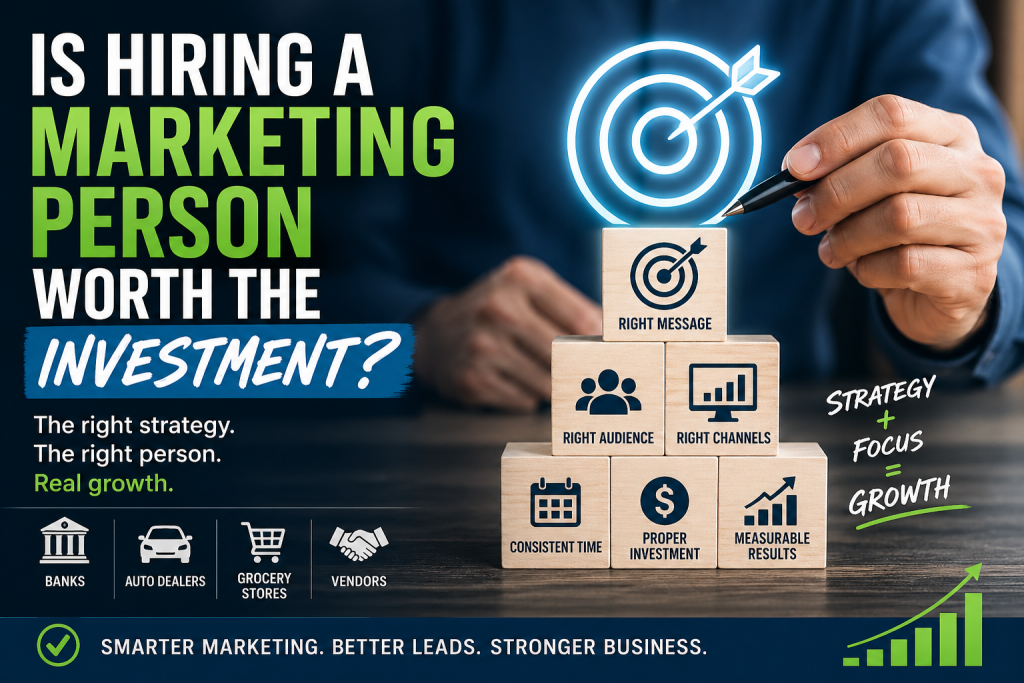

Short answer?
Yes.
But only if you’re ready to do it the right way.
I work with local businesses every day — banks, auto dealers, grocery vendors — and I see the same pattern over and over.
A business grows to around $1 million in revenue. Things are decent. Word of mouth works. The owner hustles. Sales are steady.
Then it stalls.
Leads flatten out. Competitors get louder. Growth feels harder. And that’s when the question comes up:
“Is hiring a marketing person worth it?”
Let’s break it down honestly.
Why Businesses Feel Stuck Around $1M
At a certain stage, hustle stops being enough.
- Your personal network is maxed out.
- Referrals aren’t growing.
- Organic social media isn’t predictable.
- Competitors are running targeted ads.
You can’t “wing it” into your next level of growth.
Marketing becomes the lever that breaks the ceiling — but only if it’s done strategically.
Why Most Local Businesses Think Marketing Doesn’t Work
Here’s the hard truth.
Most businesses don’t fail at marketing.
They fail at execution.
I constantly see business owners:
- Boost random posts on Facebook.
- Run Google ads without understanding the platform.
- Hire someone on Fiverr without knowing how to manage or measure the strategy.
- Let a salesperson “try ads” without defining an ideal customer profile.
- Spend money for 30 days and expect magic.
That’s not marketing. That’s gambling.
And gambling feels expensive.
When targeting is off, messaging is generic, and platform setup is sloppy, money disappears fast. Then the business owner says, “Marketing doesn’t work.”
No — random marketing doesn’t work.
What Actually Makes Hiring a Marketing Person Worth It
Hiring a marketing professional becomes worth it when:
- You can commit to at least 3 months (6 months is better).
- You’re willing to invest real budget — not “dip your toe in.”
- You’re ready to clarify your messaging.
- You’re ready to define your ideal customer clearly.
- You understand that momentum takes time.
Marketing is not a light switch.
It’s momentum.
And momentum requires consistency.
Real Examples From My Experience
Auto Dealership Group (6 Rooftops)
This group wasn’t small. But like many dealers, they were fighting for monthly quotas.
Instead of random digital ads, we built timely, targeted CTV campaigns with strong, clear calls to action. We used in-house targeting tools to reach the right audiences — not just broad local traffic.
Result?
They didn’t just hit quota. They exceeded it.
Why?
Because the messaging was intentional.
The timing was strategic.
The targeting was precise.
And the call to action was strong.
Not random. Structured.
Grocery Vendor – Events & In-Store Sales
A large grocery vendor needed to move the needle with vendors and drive real in-store activity.
We didn’t just run ads.
We built event-focused campaigns using a coordinated mix of broadcast and digital marketing. The message was aligned. The audience was intentional. The channels worked together.
Result?
Increased ticket sales.
Stronger vendor engagement.
Measurable in-store lift.
That’s what happens when marketing is orchestrated — not scattered.
When Hiring a Marketing Person Is NOT Worth It
Let’s be clear.
It’s not worth it if:
- You can’t commit to at least a 3-month campaign.
- You’re unwilling to invest proper budget.
- You expect instant results.
- You just want to “try a little something.”
- You’re not ready to really lean in.
Dipping your toe in will not work.
Marketing compounds over time. The data improves. The messaging sharpens. The targeting gets smarter.
But that only happens if you stay in long enough.
The Real Question
The question isn’t:
“Is hiring a marketing person worth it?”
The real question is:
“Are you ready to stop gambling and start building a real growth system?”
If you’re stuck at a revenue plateau…
If leads feel inconsistent…
If competitors are getting louder…
If you’re frustrated with your current ad spend…
Then yes — hiring the right marketing person can absolutely be worth it.
But only if you’re ready to do it the right way:
- Clear messaging.
- Defined ideal customer.
- Strategic targeting.
- Strong calls to action.
- Consistent execution.
- Enough time and budget to let it work.
When those pieces align, marketing stops feeling like an expense.
It becomes leverage.
And leverage is what breaks ceilings.